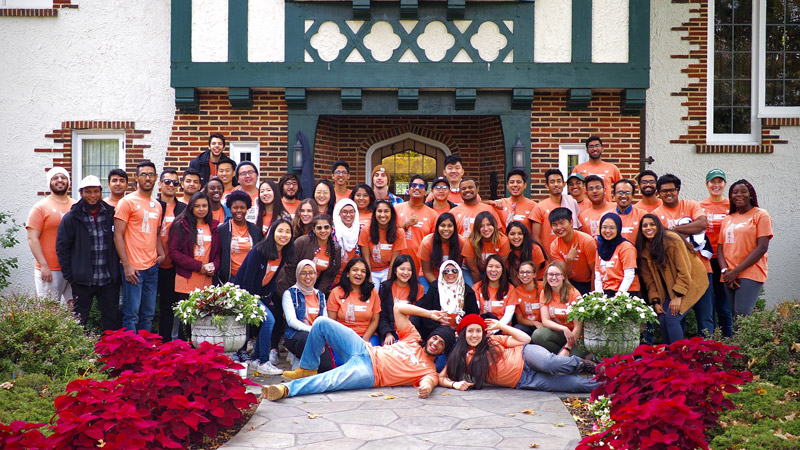
Global Detroit, a regional economic development organization that develops and implements immigrant-inclusive policies, practices, and programs, has released the first Michigan data report to utilize new federal data tracking international students working after their graduation. // Photo courtesy of Michigan State University
Global Detroit, a regional economic development organization that develops and implements immigrant-inclusive policies, practices, and programs, has released the first Michigan data report to utilize new federal data tracking international students working after their graduation.
The findings show such international students are a large source of high-skilled talent, helping Michigan employers to fill tens of thousands of critical STEM positions.
Of the time period studied between 2013-2022 (new data available), more than 97,000 jobs in Michigan were filled by international student graduates working on the Optional Practical Training (OPT) portion of their student visas.
“Attracting and retaining the talented students at Michigan’s world-class universities is key to filling the jobs of the future, growing the economy, and building on Michigan’s heritage of innovation,” says Glenn Stevens, executive director of MichAuto at the Detroit Regional Chamber. “Global Detroit’s research provides a helpful foundation on which we can bolster the high-tech talent pipeline.”
According to Global Detroit, more than 50,000 engineering jobs in Michigan alone were filled by international students working on OPT during the decade studied.
In addition to uncovering the STEM talent contributions after graduation, the report highlights international students’ $1.4 billion in annual spending in Michigan’s economy.
“International students raise the level and quality of research, scholarship, and innovation at Michigan’s public universities,” says Daniel Hurley, CEO at the Michigan Association of State Universities in Lansing.
“They diversify the student experience and play a critical role in preparing Michigan students for the global economy. Additionally, through their spending, international students contribute to the economic vitality of local businesses and generate much-needed tuition revenue for our state’s public institutions.”
The Global Detroit data report taps into new national OPT data, obtained through Freedom of Information Act (FOIA) requests made by the nonprofit organization and other national partners.
Prior to the data set being released and updated by the U.S. Department of Homeland Security in late 2024, the public had never been able to analyze the millions of individual records to understand how OPT usage impacted a state or local economy.
The data set has been organized by the Institute for Progress at the OPT Observatory website (optobservatory.org).
The Global Detroit report is the first statewide analysis of the OPT data from a statewide talent and workforce perspective. Specifically, Global Detroit’s report, “Strategic Talent Retention at Michigan’s Economic Crossroads,” points out:
International student graduates working on OPT filled 97,772 positions in Michigan over the decade from 2013-2022.
The vast majority of OPT workers in Michigan (88.3 percent) were international students whose degrees were in STEM. These 86,341 STEM OPT workers in Michigan were eligible to utilize the OPT “STEM extension,” enabling them to extend their employment authorization from one year to three years total.
More than 50,000 engineers worked on OPT in Michigan during the decade 2013-2022. In fact, more than half of all of the OPT workers in Michigan (50,018 of the 97,772, or 51.2 percent) were engineering graduates working in engineering jobs. Michigan retained a higher percentage of its engineering students over the last 15 years than any other states in America, except California and Washington.
86,214 of the 97,772 (88.0 percent) international student graduates working on OPT in Michigan over this decade had obtained a master’s degree or a Ph.D.
International students working on OPT can be hired by employers without filing any additional visas, incurring visa filing or attorney fees, or requiring additional employer expense.
“This is groundbreaking research that no other state has produced” says Steve Tobocman, executive director of Global Detroit, and one of the report’s primary authors. The research report is part of an ever-growing body of Global Detroit data on the benefits of building an immigrant-inclusive economy.
Global Detroit worked with the University Research Corridor, University of Michigan, Michigan State University, Wayne State University, University of Michigan-Dearborn, Eastern Michigan University, Oakland University, Lawrence Technological University, and private sector advocacy groups to launch in 2011 the Global Telent Retention Initiative (GTRI), the nation’s first international student retention program with support from the New Economy Initiative.
Over the past decade, GTRI has worked with scores of Michigan companies, hosted job fairs and employer legal workshops, and supported thousands of international students in preparing themselves for entering the Michigan workforce and connecting with unmet talent needs in the state economy.
The report highlights that Michigan is in jeopardy of losing its leadership position on increasing the retention of international student talent.
“There is too much opportunity for Michigan to not invest in this important activity,” says Khadeejah Lasuc Lewis, director of talent initiatives at Global Detroit, and the report’s other primary author.
“We will need to secure additional funding to continue this important programming beyond the end of the fiscal year. I cannot identify a single more impactful investment of corporate, public, or philanthropic dollars than to retain this level of talent who are already in Michigan and eager to stay here to pursue the American Dream.”
Funding for the research was provided by the Fakhoury Global Immigration and the Michigan Global Talent Initiative.
To access the research report and an executive summary, visit here.