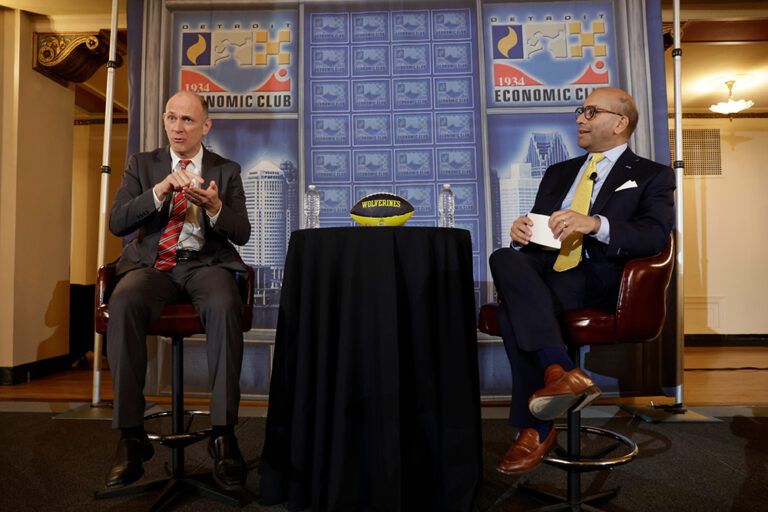
Austan Goolsbee, president of the Federal Reserve Bank of Chicago (left) talks with Sandy Baruah, president of the Detroit Regional Chamber, during his Detroit Economic Club appearance. Photo by Jeff Kowalsky/Detroit Economic Club
Federal Reserve Bank of Chicago President Austan Goolsbee cautioned that the U.S. economy is entering a period of heightened uncertainty, with tariffs and rising energy prices threatening to reignite inflation even as growth slows and hiring weakens.
Speaking with Sandy Baruah, president and CEO of the Detroit Regional Chamber, Goolsbee told a Detroit Economic Club audience the economy is showing signs of strain that do not fit the pattern of a traditional recession, complicating the task facing central bankers.
“What worries me most right now is the possibility of stagflationary shocks,” Goolsbee said, referring to the combination of slower growth and renewed price pressures. “Oil prices rising before tariff-related inflation has had time to fade is exactly the kind of sequence that can put the economy in a very uncomfortable place.”
Inflation Progress at Risk
Goolsbee emphasized that the Federal Reserve’s primary focus remains its dual mandate of price stability and maximum employment. After several years of elevated inflation, he said the Fed had made notable progress in bringing price growth down toward its 2% target — without triggering a recession, a rare outcome historically.
That progress, however, appears increasingly fragile, especially while the inflation rate remains above the Fed’s 2% target rate.
“We were making progress, then we stalled, and now inflation has been inching back up,” Goolsbee said. “The longer inflation stays above target, the more it gets baked into wages and prices. That’s when it becomes really difficult to unwind.”
Baruah noted that some major bank executives have recently warned inflation could climb back toward 4% this year, a scenario Goolsbee described as “deeply concerning.”
“If people come to expect higher inflation, it becomes self-reinforcing,” Goolsbee said. “That’s a bad outcome for workers, businesses, and ultimately consumers.”
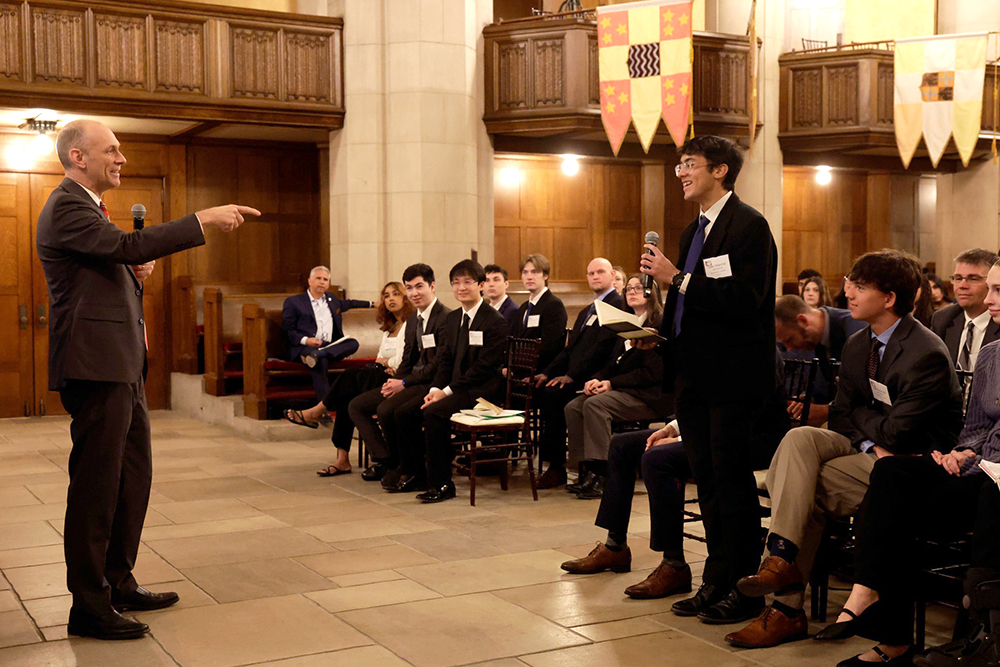
Austan Goolsbee – President & CEO, Federal Reserve Bank of Chicago speaks to the Detroit Economic Club at their meeting held at The Masonic in Detroit, Michigan, on April 7, 2026. (Photo by Jeff Kowalsky, Detroit Economic Club)
Tariffs and Energy Add Pressure
A central theme of the discussion was the economic impact of tariffs and their outsized effect on the industrial Midwest, particularly Michigan.
Baruah pointed out that Michigan is among the states most exposed to tariffs due to its reliance on the automotive and manufacturing supply chain. Goolsbee agreed, saying that while some tariff exemptions have eased initial fears, costs remain elevated and uncertainty persists.
“Modern manufacturing runs on just-in-time supply chains,” Goolsbee said. “When fuel prices jump, those costs ripple through everything—transportation, parts, logistics. That feeds into prices very quickly.”
He added that agricultural producers are also under pressure from a combination of higher input costs, weaker commodity prices, and retaliatory trade measures that have limited export markets.
A Strange Labor Market
Despite these headwinds, Goolsbee said the labor market remains historically strong, with unemployment still low by long-term standards. At the same time, hiring has slowed sharply — an unusual combination.
“Low hiring feels like a recession, but low layoffs don’t,” he said. “Seeing both at the same time is strange, and I think uncertainty is a big driver. Businesses are waiting to see whether these shocks are temporary or persistent.”
Baruah raised concerns about younger workers and recent college graduates, who are often the first to feel the effects of a slowdown. Goolsbee acknowledged the stress that accompanies weak hiring but said there is little evidence that artificial intelligence is currently driving job losses across the broader economy.
“The adoption of AI just isn’t widespread enough yet to explain what we’re seeing,” he said. “These are deeper cyclical and policy-related factors.”
Fed Independence and a Data-Driven Approach
Goolsbee stressed the importance of Federal Reserve independence, arguing that insulating monetary policy from political pressure is essential to controlling inflation over the long run.
“There’s nothing in the law that says our job is to make markets or politicians happy,” he said. “It says stabilize prices and maximize employment.”
He described his own policymaking philosophy as rigorously data-driven, joking that he prefers to be a “data dog” rather than a “hawk” or a “dove.”
“I look at everything—hiring rates, vacancy rates, layoffs, private-sector data,” Goolsbee said. “You have to sniff every piece of information that hits the floor.”
Cautious Optimism on Consumers
Despite his concerns, Goolsbee said the resilience of the U.S. consumer continues to be the economy’s strongest support. Household incomes remain solid, and spending has continued even as consumer sentiment surveys show widespread pessimism.
“That disconnect has been one of the biggest surprises of the last few years,” he said. “As long as consumers keep spending and incomes hold up, the expansion can continue.”
Baruah framed the moment as a critical test of whether those consumers can withstand another round of price pressures. Goolsbee agreed, saying the worst-case scenario would be a collapse in confidence that pushes the economy into a stagflationary downturn.
“That’s what keeps me up at night,” he said. “What helps me sleep is knowing that productivity has improved, entrepreneurship remains strong, and the labor market still has real underlying strength.”
For now, Goolsbee said, the path forward depends on how quickly current shocks fade — and whether inflation expectations can remain anchored.
“We’re navigating conditions we haven’t really seen before,” he said. “That means humility, vigilance, and a relentless focus on the data.”