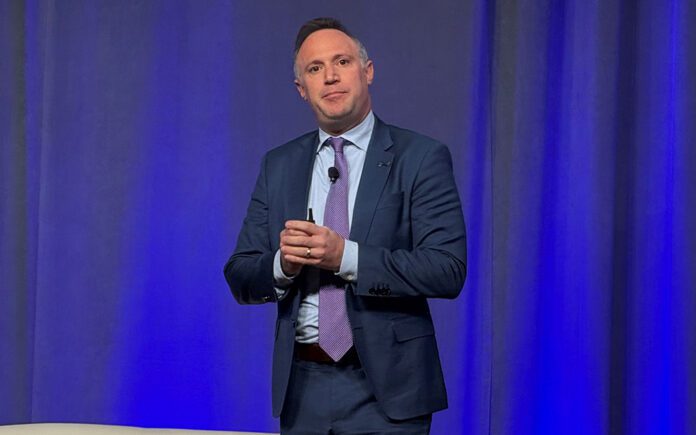
Bedrock CEO Jared Fleischer talks taxes during the Detroit Policy Conference at The Hudson in downtown Detroit.
Jared Fleischer believes one of the key to finding economic success is acknowledging that “place matters.”
Fleischer, the CEO of Bedrock, said one of the reasons Michigan is struggling to find a higher level of success is the state’s fall in terms of personal income. He pointed out that he learned at a recent conference that Michigan has fallen from the top 10 in personal income to somewhere around 40th.
And he believes he knows why.
“One of the fundamental reasons why is because we do not attract young talent,” Fleischer told the crowd gathered at the Detroit Policy Conference at The Department at Hudson’s in downtown Detroit, where he was the keynote speaker. “That is the engine of economic growth, that business follows talent. That high-wage, high-tech business and modern economy follows talent. If you don’t have talent, you don’t get the kind of growth that lifts wages across the state.”
To illustrate his point, Fleischer pointed to destinations such as Austin, Texas, Nashville, Tenn., and the Silicon Valley that are fast-growing because they leveraged what they have to offer to attract new talent and, as a result, new business.
“Austin was nothing” 20 years ago, Fleischer pointed out. Now, he said, it’s one of the fastest growing metro (areas) in the country
“Place is a huge part of that story,” he said. “Restaurants, live music, entertainment, people wanted to be there, talent started going there. Business followed. Nashville, Nashville became a place that young people wanted to go to. Live music, a vibrant place. Young people started making a destination business. Place matters.”
He also pointed to Grand Rapids, which he said is “an engine for growth.” Why?
“Because it’s a cool city,” Fleischer said. “People want to be there. Grand Rapids is defeating Chicago in the net migration battle. And what have the civic leaders of Grand Rapids done? They’ve doubled down on that. Their entire riverfront is being transformed. A new amphitheater, soccer stadium, new housing, rail, trails, bars, restaurants, hotels. It’s going to be a magnet for talent for the next generation.”
Fleischer said it got him thinking about areas like the Detroit riverfront, the Renaissance Center and the “40 acres of empty riverfront that we have here.”
“How incredible will it be if that is the best waterfront destination in the country, fully thriving and an engine for attraction and engine for talent,” he said. “If Michigan is going to thrive, those are the kinds of places we need to build. Those are the kinds of destinations that we need to build. And it’s not just in Detroit.”
To do it, Fleischer said, the state has to attract talent, which is how the state will attract business.
“Attracting the businesses of the future is how we go from being a bottom 10 state in terms of our wealth and prosperity back to being a top 10 state,” he said. “And to do that f… we need partnership from the state. And at the end of the day, it’s not just about these individual projects, it’s about do we want to be at the bottom or do we want to move back towards the top?”
One way to attract business to Michigan, and specifically to the Detroit area, is to reform Detroit’s property tax system, which he believes will make the city more attractive to residents, developers and businesses.
During his keynote address, Fleischer described a package of reforms around land value tax, local option excise tax and tax abatement reform. And he suggested there’s no better time for the discussion with the election of new Mayor Mary Sheffield.
“We have a real political moment here for lowering property taxes in the city of Detroit,” Fleischer said. “Lower property taxes is a top priority for (Sheffield), it’s a top party for our city council and it’s a top priority for our leaders at Lansing. My goal today is to throw out some conversation starters. I don’t know if these are the absolute right ideas. I certainly don’t think they’re the be all and the end all. The point is throw out conversation starters and keep this critical conversation going.”
Detroit’s property tax rate of 82.2 mills, he said, is the highest property tax rate among major cities in the country, some 2.25 times what it is in major cities. That kind of tax rate, he said, discourages development and forces most projects to seek tax abatements.
That’s where Fleischer’s proposed solutions come in. He believes his ideas could generate at least $65 million in new revenue, possibly giving the city the ability to lower property tax rates by up to 8 mills. If revenue reached $80 million, he said, the rate could drop by as much as 10 mills.
Here are Fleischer’s “tools” to get it done:
Establishing a more modest land value tax could help reduce taxes on occupied properties.
Implementing a local option excise tax focused on the greater downtown area, which draws in visitors and tourists. He believes it would be a more efficient tax structure.
Rather than higher, short-term tax abatements – most are 10-year abatements — Fleisher believes smaller abatements over longer periods “could be half as generous, twice as long,” setting up a soft landing for developers and steady revenue for the city.
“If each of these policies is independently a better approach for our community and a better approach for our economy, it’s a win-win,” he said.